
We left Beaufort mid morning and followed the river to Port Royal Sound. We were very careful to leave so that we would be going through the low shoaling areas on a rising tide as we were warned that there was little money for dredging the ICW in South Carolina and Georgia. It was a beautiful sunny day with a fair wind and we even had our main sail out. We passed shrimp boats out in the sound and even wondered if maybe we could have shrimp for dinner when we stopped for the night.
 Suddenly Roman yelled “We have no rudder. The steering’s gone!” I took over the wheel while Roman climbed down under the cockpit to check the rudder quadrant. I put out an alert over the VHF that we had lost the steering of the boat and could not control where we were going. I also called Tow Boat US for assistance.
Meanwhile Roman found out that bracket that holds the hydraulic cylinder was broken from the strut to which it was connected. The bolts were sheered off completely. Roman went up and took down the sails while I diligently watched the shrimp boats. Roman, being the creative genius that he is, went below and managed to secure the bracket temporarily with a C-clamp and vice grips. We regained enough steering to slowly veer away from the shrimp boats that had pulled in their nets when hearing that we had no steering control. We had to be very gentle with the rudder steering so that clamps would not come off.
The shrimpers had let their nets go into the shipping channel and Roman figures that we passed over a shrimp net even though we were far away from the shrimp boats. He thinks that the shrimp net caught the rudder and pulled it. Since we were sailing he originally thought that it was just a gust of wind and countered the steering. At that time the steering went and thus broke the bracket. We later found out that the nets can be half a mile or longer.
 We were very lucky that the dispatcher, Dana, who responded to our call for assistance from Tow Boat US, was very knowledgeable about the area and what marinas were equipped to handle the fact that we would need a portable welder to repair our problem. The only place that could service us would be Savannah Georgia.
 He called a towboat out of Beaufort that took us midway and then we were transferred to a towboat out of Savannah and taken to Hogan’s Marina on Turner Creek, Wilmington Island which is a suburb of Savannah Georgia.
Here we are being towed to Savannah. We were towed for over 6 hours! Shoaling continues to be a challenge even with experienced operators like Towboat US. While being towed, we hit a shoal at about 7 knots and I was thrown right across the boat. It took a couple of weeks for those bruises to heal. At Thunderbolt, Georgia we passed the annual town parade of boats all decked out in Christmas lights. It was quite the sight!
 It was about 8:30 Saturday evening when we finally arrived at Hogan’s Marina and it was a challenge docking the boat in the dark. I shone a flashlight on the decks while the towboat operator, Frank, tried to guide us in. A fter three tries, we did it! We made to the fuel dock where we stayed for the remainder of our visit. Our keel was too deep for the water around the docks.
Two other boaters came to help us dock. They were fixing up their boats to travel south as we were. We spent many interesting hours chatting and laughing with our new friends Steve and Steven.
 Here we are enjoying a glass of wine after dinner. Steve is from Alaska and bought his boat sight unseen from the internet. He flew down, picked it up and sailed it to Hogan’s Marina to check it out before he sails to the Bahamas and beyond. Steve is a Czech from Montreal who has spent years sailing to Honduras, San Salvador, Panama, all parts of Mexico and even lived for five years in Costa Rica. He has been preparing his boat at Hogan’s Marina last January through April and this year for the past two months and is planning to sail south in January.
 Hogan’s Marina is a no frills place with washrooms and the one shower only open 8 to 5 and has no internet. It is primarily a fishing marina with motorboats stored on a three tier rack building. Boat owners phone one hour before they want their boat and a crane gets their boat and puts it in the water. When they finish using the boat, it is again stored out of the way on one of the tiers. It is a very efficient system as the laws prohibit the building of more docks on Turner Creek. The marina is always full and there is a waiting list even with the price of gas that it is. The people at the marina were wonderful. Bubba, the manager, arranged for a second welder when the first one, who came to look at the problem, could not help us.
 Roman made a pattern for the new brackets; the second welder had a portable welder and between them, they fixed the problem. Jody, who worked in the office, drove me to the library so that I could access the computer. The marina provides areas for the fisherman to clean their fish and on the weekend there were many fishermen cleaning their fish. One of the fishermen gave me some red bass fillets and they tasted absolutely scrumptious. The fish literally melted in our mouths.
Steven let me tag along with him to Wal-Mart, Target, West Marina, Outdoor World (what a place) and Publix. We did all that in one afternoon. Coming out of Walmart on the outskirts of Savannah, Steven and I witnessed a spectacular sky. Luckily I had my camera.

The next day Roman and I went into Savannah where we took a bus tour around the city.

 Savannah is the most charming city that we have visited so far and one of the largest. It took us over an hour to go into downtown by bus from Wilmington Island. Savannah has never had a hurricane and all the buildings are beautifully preserved. Generally homes were built in the colonial style of architecture and most are painted white with soft pastels intermingled.

 Balconies and verandas wrap right around the buildings. As in Charleston and Beaufort, homes have the first floor up a flight of stairs. At the time, people thought that the higher up you were, the cooler it would be. So slaves and servants lived in the coolest part of the home on the lower level. Properties were taxed on the number of doors and the number of closets that a building had. Thus to keep taxes down, homes had large narrow windows through which a person could step outside onto the balcony instead of doors. Few rooms had closets and large wooden wardrobes were the fashion.
 Moss-laden old oak trees line most of Savannah's streets..
 Savannah was the last city established by Britain in America. The city’s two mile square historic district is the largest urban National Historic Landmark with more that 1000 architecturally or historically significant structures restored and in use. Its city plan is distinguished by the fact that was a planned community and is built around a repeated pattern of multiple squares and streets that line these squares. Each of the 21 Historic Squares is named for a historical figure or event.
 One, for example, is dedicated to the Haitians who came to fight in the War of Independence from Britain. All statues face the direction from which the enemy came. For example, the ones honouring the Spanish-American War heroes face the south. Each square is picturesque and beautifully maintained. These squares are often rented out to individuals for such private functions as family gatherings or weddings. The price is only $50.00 which includes a policeman for 4 hours to control crowds. Quite a bargain!
 One of the interesting sights was the police barracks with the old police cars in front. We managed to get a picture from the tour bus.
 The Cathedral of St. John the Baptist is very reminiscent of churches we have seen in Europe was awesome. It was built about the same time as oldest black church in the United States which is also located in Savannah. What a contrast!
 Cotton was king here for a long time and the waterfront,
 which reminded us of old Quebec City, is lined with a cobblestone street and picturesque buildings. The backs of these buildings were built with overhead factor walks named for the cotton "factor" who would walk along the second story platforms and inspect the bales of cotton stored below.
 Several blocks of the older part of the city are closed to vehicular traffic and one afternoon we wandered in and out of the quaint shops.

Roman found time to make new friends. This one reminded me of someone. UMMMM, let me think, Oh yes, I do believe that is Marilyn all dressed up for Christmas.

 Goodby Savannah!


 The lowlands have a beauty all their own. It was difficult to put down an anchor in the strong current but we’re pros at this now and have the technique down pat. There was another small sailboat that came into to anchor in the same area where we were. He dropped his anchor twice and still it dragged and the boat was pulled by the current toward us.
  Roman had to sound his horn to bring it to the sailor’s attention. He was alone in the boat and found it difficult with the current to drop the anchor and then run back to the tiller to steer. On the third try, the anchor seemed to hold.
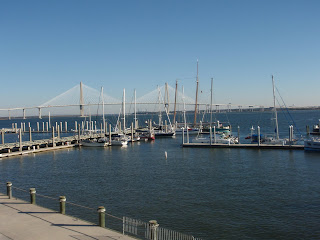
 It was relatively calm at sunset before the winds picked up to over 25mph. And all night we were tossed about between the current and the wind. Roman was up several times at night to check our anchor. The next day it turned much colder and on went layers of clothing. The forecast was 25 knot winds with gusts up to 35 knots. It seemed much worse as we did not have any wind breaks at all and were wide open. The winds did not seem to bother the dolphins which swam and dived round our boat. We stayed put especially after I talked to the Charleston Maritime Centre where we were headed. The dock master told us their boats were being tossed around and suggested that the bridge just before Charleston might not open in these winds and that we were much better off where we were rather than trying to make it into Charleston.
 This seemed a good day to bake. I checked out what ingredients I had and made date squares which turned out to be really fantastic. I made stuffed mushrooms, baked chicken breasts with herbs and a tomato and red onion salad. Just because you live on a boat does not mean that you do not eat well.




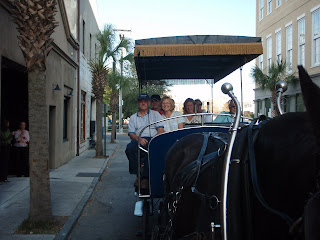


 Apparently one body was buried and covered with lye so that it would disintegrate quickly. When it came time to bury the next one, the first body would be covered with a shroud and the process repeated. The saddest tombstone we saw was one with several children dying close together indicating the year, the month and even the days the children lived. So many children died young!
 We went out for dinner at AW Shucks Seafood Restaurant which had very interesting pictures on all the walls.
 The food was very good but the portions, as all portions in the United States seem to be, were huge. We could barely finish half of our dinner. We noticed that the lunch portions are what we would eat for dinner and the American dinner portions are twice that!


