Friday, January 4, 2008

20. Charleston, South Carolina


Just before Charleston we anchored in Dewees Creek which is wide and deep with a swift current. It is very flat and open and meanders its way through grasses growing out of the water on both sides of the creek. This area is called the lowlands of South Carolina.

The lowlands have a beauty all their own. It was difficult to put down an anchor in the strong current but we’re pros at this now and have the technique down pat. There was another small sailboat that came into to anchor in the same area where we were. He dropped his anchor twice and still it dragged and the boat was pulled by the current toward us.


Roman had to sound his horn to bring it to the sailor’s attention. He was alone in the boat and found it difficult with the current to drop the anchor and then run back to the tiller to steer. On the third try, the anchor seemed to hold.

It was relatively calm at sunset before the winds picked up to over 25mph. And all night we were tossed about between the current and the wind. Roman was up several times at night to check our anchor. The next day it turned much colder and on went layers of clothing. The forecast was 25 knot winds with gusts up to 35 knots. It seemed much worse as we did not have any wind breaks at all and were wide open. The winds did not seem to bother the dolphins which swam and dived round our boat. We stayed put especially after I talked to the Charleston Maritime Centre where we were headed. The dock master told us their boats were being tossed around and suggested that the bridge just before Charleston might not open in these winds and that we were much better off where we were rather than trying to make it into Charleston.

This seemed a good day to bake. I checked out what ingredients I had and made date squares which turned out to be really fantastic. I made stuffed mushrooms, baked chicken breasts with herbs and a tomato and red onion salad. Just because you live on a boat does not mean that you do not eat well.

When we first entered Charleston Harbour we saw a mast sticking out of the water. It looks like one sailboat did not make it any further south. Look closely and you can see it to the left of the line of boats. We originally had planned to anchor near the sunken boat but we soon changed our mind when we realized that we had no idea just as there were no markings to indicate where the hull of the boat was located under the water. We then anchored not far from Charleston Yacht Club. The members are very active in the club which organizes many social gatherings. When we were there a committee was putting up Christmas decorations and invited us to have a spot of eggnog or a drink with them. They were very helpful in giving us directions and one member even drove us to a K-Mart. We took the bus back.


The tides are high in the area. Here you can see what the docks around the Yacht Club look like at low tide.


Charleston, South Carolina, is a sea of pastel houses with brick walled gardens with lacy iron gates and only the church steeples reach out to the sky. There are no skyscrapers at all. A city ordinance restricts the height of any building over eight stories. There are a few exceptions but they are very rare. An architectural review board even approves the colour with which you may paint your home. There is an approved palette from which you choose several colours and then one of the colours is accepted by the board.

Other city law states that anything over 75 years old must be maintained in the condition that it was at the time and that no changes can be made. The Catholic Church does not have a steeple as it did not yet have one when that law came into affect and now it cannot be added. Hurricane Hugo did extensive damage and one bank was destroyed except for the old wooden door. The new building that went up had to incorporate the door as it was over 75 years old.

This is an older structure that is being propped up while the new one will be built around it.
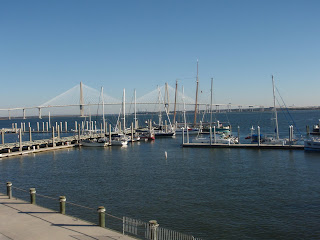
The Charleston Maritime Centre where we stayed for several nights was right in downtown Charleston and we could walk to the historic district, an immense supermarket and a scrumptious bakery that was only “a football field away” as we were told. Our boat is the second from the end of the dock extending from the right side of the picture.


We walked to the Slave Market which was not a place where slaves were sold as we initially thought (we saw that later) but a place where slaves came to barter and trade their wares after the Civil War. It was built on a tidal creek which was filled in. Charleston is on a peninsula and much of it is built on reclaimed and filled in land which is very prone to flooding. All homes are built such that the first floor is up a few steps and the ground level has openings on the sides so that water can flow through under the house. Needless to say there are no basements.


Here George Washington is smiling down upon us as we stop in George Washington park.


Charleston is a city steeped in history. I enjoy reading historical novels and it was very interesting to see the jail as well as the hanging tree which are featured in so many novels. The first shot of the Civil War was fired by South Carolina at Fort Sumter which was held by Union forces. South Carolina was also the first state to secede from the union and join the Confederates.


Here is a submarine that was actually used during the American Civil War.


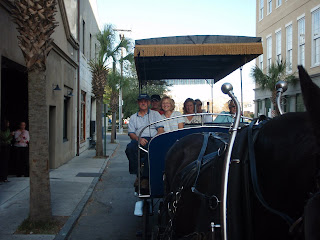
We went on a carriage tour of the city and the waterfront. The guide told of much of the history and some of the folklore of the city. We heard about the pirate, Blackbeard, who stood 6ft. 4in. tall in a time where most men were less than 5½ft. He had an enormous black beard which he used to set afire to psych out his enemies before he boarded a ship. It is said that it took 10 men to kill him with knives. Beaureguard, the Gentleman Pirate, was hung with 40 other pirates on the waterfront, the Battery, and left to hang until they became skeletons to serve as warning to other pirates.


Alex and Christopher, this pirate was in front of the market where we got your pirate"change colour in the sun" T-shirts.


One of the homes that we saw on our tour belonged to the owner of the Piggly Wiggly Grocery stores. On his front lawn he has two statues of pigs which he dresses appropriately for the season. When we went by, the pigs were dressed up for Christmas with hats, coats and scarves. The pictures that I took from the carriage did not capture this wonder and we never had time to go back there. As soon as the American Thanksgiving was over in late November, out came the Christmas decorations everywhere.


The best tour we took in Charleston was the after dark Ghosts and Graveyards Tour where we heard stories of people being buried alive and of ghosts who still roam about the city. We actually saw what looked to be a ghost like figure on one of the church steeples. It was the way the lighting cast a shadow at a certain time of night. Ask us when we get home to tell you some of them, particularly about the first female serial killer story.

The third oldest church in Charleston is the Congregational Church which is an old round brick building with a graveyard attached. People were buried in crypts or mausoleums, in raised coffins so that bodies would not come up during flooding and in regular graves. It was the custom to bury several members of one family in one grave or raised coffin. Apparently one body was buried and covered with lye so that it would disintegrate quickly. When it came time to bury the next one, the first body would be covered with a shroud and the process repeated. The saddest tombstone we saw was one with several children dying close together indicating the year, the month and even the days the children lived. So many children died young!
At the Charleston Maritime Centre we met a very interesting couple, Don and Judy, from California. We found out that we had a lot in common, children and grandchildren and the time passed too quickly with them. We shall be sure to keep in touch.

We went out for dinner at AW Shucks Seafood Restaurant which had very interesting pictures on all the walls. The food was very good but the portions, as all portions in the United States seem to be, were huge. We could barely finish half of our dinner. We noticed that the lunch portions are what we would eat for dinner and the American dinner portions are twice that!

Saturday, December 22, 2007

19. Waccamaw River


We took a side trip off the ICW onto the Waccamaw River which we found to be one of the most scenic parts of the ICW. Moss draped cypress trees lined its sides and we even saw turtles sunning themselves along the banks of the river. This was one part of the ICW where we did not see any other boat, person or building. We were one with nature. Wildflowers of all descriptions grow in the cypress stumps and the water is the colour of tea.


We sat out on deck well into dark, in spite of the mosquitoes, just drinking in the beauty and peacefulness of our surroundings and listening to the sounds of nature. The tops of the trees stood out like sentries against the night sky. It was truly awesome!


In the morning when Roman was pulling up the anchor, we could hear the sounds of shots being fired and several boats went by with men dressed in camouflage clothing, hunters, we presumed.


Georgetown in South Carolina is a charming picturesque town with a promenade that runs along a good part of the well protected harbour in which many boats anchor. When we were there, it was difficult finding a spot to drop your anchor. The shore is lined with places to see and many places to eat or just relax with a drink and take in the view. The town provides an excellent free dingy dock.


There are actually alligators off shore although we did not see any. Roman looks like he does not believe the sign.


The main street is filled with many appealing shops and the town has preserved a large historic district. Georgetown has the only steel plant in the U.S. that makes steel rods used in concrete, tires etc. It operates round the clock providing employment so the town has an air of prosperity about it.


At night we play cards. We have learned the official game of Gin Rummy and Roman has become quite the player and constantly wins! He usually comes up from behind. I now call him the Stealth!

Wednesday, December 19, 2007

18. Bridges


The ICW is like a highway with many boats, most of them going south. There is very little opportunity to sail within the ICW as it is very narrow in most places. We have ended up motoring most of the time. Our maximum speed is 6 knots. If the current and the wind are with us, we can get up to 7 knots. We average about 5 knots an hour. Of course the power boats pass us going much much faster and we are bounced about in their wake. It seems that few have the common courtesy to slow down when passing sailboats.


One of the interesting parts of the ICW is the amount and variety of bridges that you must pass. Most bridges are 65 ft. in height which is plenty for us to pass under. However there are a variety of bridges that may have as little as 6 ft. vertical clearance. Most of these bridges have scheduled opening times usually on the hour although there are some that open on demand. Some have restricted times such as rush hours when they do not open to traffic at all. Some will not open if the winds are above a certain speed, usually 35 mph. Some can remain closed at the discretion of the bridge master in bad weather. Some of the railway bridges remain open unless a train is scheduled to pass.

Bridges are constantly under repair. This is the Lions Bridge in St. Augustine Florida which is being rebuilt. This has been underway for two years and the completion date is 2009. This is not a quick process. A temporary bridge has been built to accomodate traffic over the bridge.


Sometimes you pass under a bridge which you know is supposed to be 65 ft. high but as you go under it and look above, you are sure that you are going to shear the top of your mast off.


Here are some pictures showing how close the mast seems to be to the bridge. Often we hold our breath as we go under.


When the currents are strong it is quite tricky waiting for the bridge to open. Some boats have even dropped anchors if the wait is a long one and the conditions are difficult. We have found that we have become quite good at gauging the speed of our boat and the current to minimize the wait. Most bridges monitor VHF 09 throughout the ICW.


Lift or Draw Bridge

This one has a railway bridge in front of the draw bridge which is also raised.


Bascule Bridge

The bridge lifts up and down to let the boats through.


Swing Bridge These are two different types but both are swing bridges.


Pontoon Bridge


The Sunset Beach Pontoon Bridge south of Cape Fear in North Carolina almost at the border of South Carolina is the last remaining pontoon bridge on the Atlantic ICW. Waiting boat traffic is usually heavy because it has zero clearance and opens only on the hour. Even the smallest of boats cannot pass through unless the span is open. When the bridge opens an entire section of the bridge which is on a pontoon moves out of the way. At periods of low tide it may be unable to open at all for several hours at a time. We were lucky with our timing and waited only about 20minutes.

17. to Southport

Southport is a gem, a quaint village with a small town basin which is lined on one side with what look like shacks from the water. These tuned out to be buildings that looked right out of a movie set and indeed we found that several movies had been filmed there and that this was the location of the T.V. series Dawson’s Creek. We arrived mid afternoon and found the free docks at the Provision Company Docks which had just closed for the season. Boaters were welcome to dock there with no hydro or water but there were toilets! I have to learn to say electricity and not hydro. When I say hydro I am usually met with a blank expression. The tides rise and fall about 6 feet here and when they are low we have to climb up the ladder to get to the top.

It was Sunday when we arrived and we decided to walk about the town. Southport has a really nice main street with picturesque little shops but everything was closed. It was hard to believe that this shop was all decorated for Christmas ans it was warm outside and no snow. We found a church and said a quick prayer. When we walked to the Visitor Information Centre, which is in a charming old house, we asked if there was a marina close by where we could have a shower. We were feeling pretty grungy! One of the volunteers, Shirley, was a wonderful human being with a heart of gold. After finding out that the local marina did not allow transient showers, she offered her own home to us. She said that she had a big house with only herself and her husband at home. Having boated herself, she knew what it was like. We were overwhelmed with her generosity. After a great dinner at a local restaurant overlooking the water, we went over to Shirley’s with a bottle of wine. Shirley and her husband, Woody, welcomed us like long lost friends and after showering in their guest bathroom, we spent the evening talking and getting to know each other. They live in a beautiful home (late 1800’s) overlooking the town bay. They have made extensive renovations while maintaining the charm and character of their home. Shirley and Woody have two boys and four grandchildren, have lived in Europe (Woody was in the army) and in different parts of the United States. They chose to retire in Southport five years ago and have never regretted it. We have met many people that have lived in many parts of the United States. It seems to us that people move about the country more readily in the U.S. than in Canada. Certainly many retire in warmer climates.

We enjoyed Southport so much that we ended spending a few days there. I tried to get internet on the boat with our WIFI antenna but the reception was very poor and I kept losing the connection., We finally gave up and went to an internet cafe in town. Roman bought three pounds of gigantic shrimp from the fish market located right on the harbour. There were large shrimp boats in the harbour that came in late at night after we had gone to bed. One was docked just next to us. This was a great year for shrimp we were told. I have never seen such huge shrimp and the taste was just heavenly. My mouth waters just thinking about them!


Shoaling is a constant problem. Often what is in the charts is not what really is. After leaving Southport, sure enough, although we were exactly between the two markers in the centre of the channel, we hit another shoal. It was a beautiful sunny day in the 60’s and we were aground. Roman’s nature is such that it is very difficult for him to sit still and wait. He tried and tried to get us off to no avail. Again we had to call Boat US. Tugboat John came from Southport to pull us off the shoal. He knew Woody and Shirley and we passed on our greetings. John was a really pleasant young man who really loved our boat and said it was a boat that made sense! He stayed to make sure that Roman’s rudder was O.K. This time it was. Next time….but that’s another story.

16. Spooner's Creek


Our next interesting stop was in Spooner’s Creek which used to be a marina at one time and now was a paradise of homes with private docks surrounding this small creek. The entrance was tricky and narrow and all the way in and all the time we were there (2 days) our depth meter read 0 which meant that we sitting on the bottom but we managed to get in and out on an inch or two we figured. Chad and LeeAnn with their smaller draft had no trouble at all. The great thing about this anchorage was that, once we rowed to shore on our dingy, it was only a short walk to a large mall which had a Best Buy and a super Wal-Mart which had groceries. We had meant to stay only the one day but there was a gale warning over the Atlantic and even though we were inland on the ICW the winds and rains were too strong for us to continue. We had thought about going to a marina about 10 miles up the ICW to wait out the storm and to have a shower but they were full. Everyone was taking shelter.

It turned out to be a good decision to stay where we were. We ventured ashore out during a lull in the rain but by the time we made it to Best Buy it was raining cats and dogs. We purchased a WIFI antenna to hopefully increase our ability to get WIFI. I have become quite the techie on this trip. I also bought an 80 GB ipod and LeeAnn and Chad were quite willing to lend me a hand with the itunes programme and to download songs on my ipod. Both were wonderful and helpful. Here is their boat after the rain.


Leaving Spooner Creek turned out to be quite an adventure. We left later in the morning so that we would be navigating the extremely narrow channel on a rising tide. We followed Chad out to Bogue Sound. I was reading the chart and steering: I turned starboard (right) to stay inside Marker #9 as indicated on the chart. Chad and LeeAnn had gone to the left. Roman abruptly yelled go right while pointing left. He took over the steering and steered exactly where we should not go. Chad and LeeAnn ran aground. Chad was yelling and waving at Roman to go the other way (the way I had originally gone; I am rubbing it in). At the last possible moment, Roman swerved and managed to avoid the shoal at the entrance of the channel. We circled around but could not get close enough to Cambyration to help them out. The wind was blowing fiercely and the current kept blowing us toward the shoal. Chad finally got into his rowboat and rowed towards us with a long rope. He struggled against the current with the waves and the wind while we willed him to make it. When he got to our boat, he looked pale and exhausted. I grabbed the rope and tried to tie around a cleat while Roman struggled to keep the boat out of the shoal. I was getting rope burn and the line kept slipping out of my fingers. I could not hold it. I yelled and Roman came to help; it took both of us to secure the line around the cleat. Roman raced back to the wheel and we watched as the current and wind helped Chad make it back to his boat. Cambyration is a lot lighter than our boat but it was still a bit of a struggle to pull them off the shoal. What a relief! Unfortunately, there was no time to take pictures.

In Spooners Creek we saw our first palm tree and we knew that we were on the right track. You can see the palm tree behind Chad and LeeAnn. Coming to the Cedar Point Bridge we saw our first dolphins. They would jump out of the water too quickly to get a picture. The scenery changed to large sand dunes along the ocean side. In Swansboro we saw many kayaks, windsurfers and surfboards on the lawns. I remember thinking that Evhen would love this area.


About 25 minutes past Swansboro, we ran aground on a shoal and no matter what, Roman just could not get us off! Fortunately Chad was further behind us and only we went aground. We phoned Boat US for a tow and a great guy came out from Swansboro with his dog Skipper. Skipper would bark and dolphins would jump out of the water. It was worth going aground just to see that. I could not get a picture of the dolphins but here is Boat Us. One of the best things that we did was to get unlimited coverage from Boat Us for the ICW. For one sum, we are covered for UNLIMITED towing on the ICW.


We arrived in Wrightsville Beach about sunset. This is where we said goodbye to Chad and LeeAnn over a nice bottle of wine. It is sad to think that we will not see them for another year when they will make their way down south as well. Right now they plan to stay in Wilmington for the next 6 months or so and travel back up to Annapolis during the hurricane season and then head down to the Caribbean.

Monday, December 3, 2007

15. Oriental

We had read that there was a town dock in Oriental where you could tie up for the night. We looked through our binoculars and saw a long dock which we assumed to be the town dock. We pulled up and there were several guys that helped us tie the boat and then told us to check in at the marina. We asked about the town dock and were given directions. We followed those directions precisely but there was a shoal which everyone swore later appeared out of nowhere just off the marina dock.


We were stuck in the shoal and there was no way that Roman could use the engine to get the boat clear. It became a project to get us clear. Several dinghies came out to try to pull us to no avail. Then the guys at the dock tried to pull our boat clear while we let out our jib but there was not even a tickle of wind.


Finally we took our spinnaker halyard and gave it to one of the dinghies who pulled it; the guys on shore heaved; one of the dinghies pushed and the other dinghy tugged at a line and we got clear!

Chad and LeeAnn caught up to us just before we were freed and took these pictures. I hope you can see the guys pulling the line on the docks.


Free atlast!


We did not want to approach any other docks and anchored out in the bay opposite the town. We spent the next day in Oriental.

I spent several hours in The Bean Coffee Shop working on my blog while Roman explored the nautical shop and hardware store. He bought odds ends one of which was a great funnel that needed. From Norfolk on, the gas pressure at the pumps is much greater than at home and it is simply impossible to pour the gas into the boat without a very long thin funnel. We had been using a makeshift funnel that I had made a out of a water bottle.

Oriental has only about 1000 people living in it full time. During the summer, the population swells astronomically. They have a very lay back attitude about life. While at the coffee shop the young man working there told us about how the town was originally named Southport. When there was a lot of confusion as there was another town in North Carolina with the same name, the post office told the town that they had to choose a different name. The story is that the mayor was walking along the beach and found a piece of driftwood with a nameplate of Oriental on it. Oriental was the name of a steamboat which had sunk off the coast some miles away. The piece of wood was taken to the post office and the question asked “Will this do?“ Thus the town was renamed Oriental. Interesting history!